

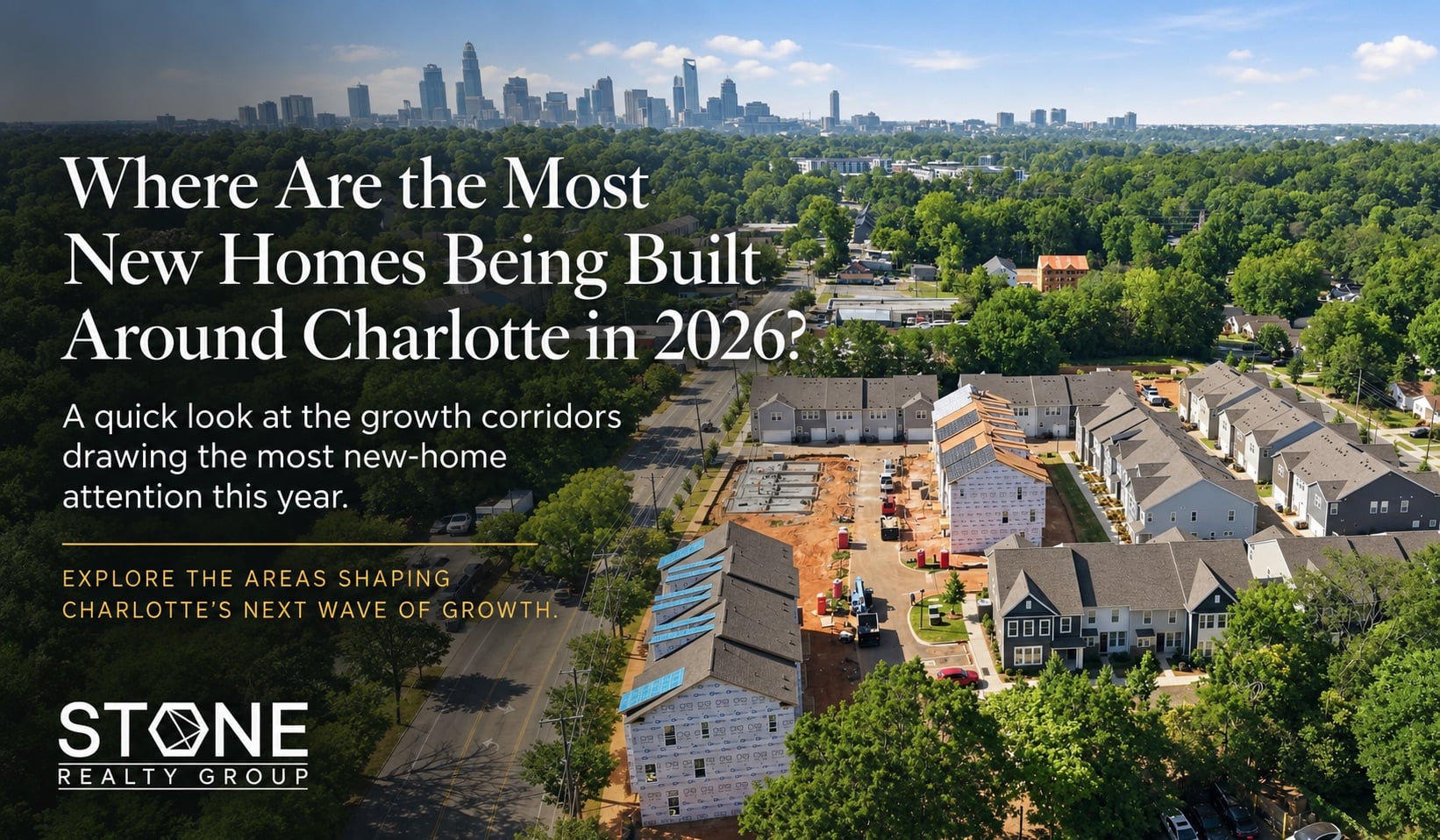
Charlotte is not adding homes in only one direction. New construction stretches north toward Lake Norman, east into Cabarrus County, south through Union County and across the state line into York and Lancaster counties.
Realtor.com’s 2026 new-construction analysis ranked Charlotte-Concord-Gastonia No. 4 among the 100 largest U.S. metropolitan areas. New construction represented 29.5% of listings during the first half of 2026. Huntersville’s 28078, York’s 29745 and Lancaster’s 29720 were among the metro ZIP codes identified for substantial new-home inventory.
The growth pattern also appears in the latest annual U.S. Census Bureau Building Permits Survey. Permit figures represent housing units authorized during 2025, not completed homes, and can include units in multifamily buildings.
Charlotte’s Biggest New-Construction Corridors
Huntersville and North Mecklenburg
Huntersville remains one of the clearest new-home hubs close to Charlotte. The 28078 ZIP code stands out for new-construction listings, with development continuing around the I-77, I-485 and N.C. 73 corridors.
Buyers can find townhomes, smaller-lot detached homes and larger planned communities while remaining within Mecklenburg County. The location can also provide access to both Charlotte and the eastern side of Lake Norman, although commute times vary considerably by address and time of day.
Union County: Indian Trail, Monroe, Waxhaw and Wesley Chapel
Union County continues to absorb a substantial share of Charlotte’s suburban expansion. The county authorized 2,707 housing units in 2025, providing a sizable development pipeline heading into 2026.
New-home inventory can be found around Indian Trail, Monroe, Waxhaw and Wesley Chapel, with options ranging from townhomes and smaller-lot detached properties to larger homes and planned communities. Pricing, taxes, HOA costs and commute patterns vary significantly by project and location.
Cabarrus County: Concord, Kannapolis and Midland
Cabarrus County recorded 1,991 permitted housing units in 2025. Development continues around Concord, Kannapolis and Midland, supported by access to I-85, U.S. 29 and portions of I-485.
One of the clearest examples of the next wave is Carolina Ridge in Midland. PulteGroup describes the development as having more than 1,100 homesites across two communities: The Retreat at Carolina Ridge and the 55+ Del Webb Carolina Ridge.
Gaston County: Belmont, Mount Holly, Gastonia and Stanley
West of Charlotte, Gaston County authorized 2,343 housing units in 2025. New neighborhoods continue expanding around Belmont, Mount Holly, Gastonia and Stanley, where developers can often assemble larger sites than they can closer to Uptown.
New supply ranges from townhomes to detached communities, including Carolina Riverside, a Del Webb 55+ community in Belmont. Buyers considering this corridor should test their commute and compare access to I-85, U.S. 74 and the Catawba River crossings.
Lake Norman: Denver, Sherrills Ford and Mooresville
Lake Norman growth is increasingly spreading beyond Cornelius and Davidson. Iredell County permitted 1,835 housing units in 2025, while Lincoln County permitted 785.
New development is particularly visible around Mooresville, Sherrills Ford and Denver. In September 2026, Dream Finders Homes began moving forward with a 163-home community in Denver, providing another sign of residential expansion along the N.C. 16 corridor. Read more about what the planned Denver development means for Lake Norman buyers.
York and Lancaster Counties, South Carolina
The Charlotte growth story increasingly crosses the state line. York County authorized 2,646 housing units in 2025, while Lancaster County authorized 1,110.
Realtor.com also identified ZIP codes in York and Lancaster among the Charlotte metro’s strongest new-construction areas. That keeps York, Fort Mill, Indian Land and Lancaster important markets for buyers comparing newer communities south of Charlotte.
Buyers comparing North Carolina and South Carolina should look beyond the home price and evaluate property taxes, insurance, HOA expenses, commuting costs and state-specific transaction considerations.
What This Means for Charlotte New-Construction Buyers
The farther buyers move from Charlotte’s established core, the more likely they are to find larger planned communities and multiple builders operating within the same corridor. That can create opportunities involving completed inventory homes, closing-cost assistance or financing promotions, although incentives vary by builder, property and community.
Buyers should compare the total cost of ownership rather than focusing only on the advertised base price. Important considerations include:
- Builder incentives and their financing requirements
- Lot premiums and structural or design upgrades
- HOA dues and planned community amenities
- Property taxes, insurance and utility arrangements
- Commute times during normal travel hours
- Nearby development and future construction phases
- How the home compares with nearby resale inventory
Our Charlotte new-construction guide covers several of these considerations in more detail.
Frequently Asked Questions
Where is the most new construction near Charlotte right now?
The broadest concentrations are in Huntersville, Union County, Cabarrus County, Gaston County, the Lake Norman growth corridors and York-Lancaster counties in South Carolina. The best area depends on commute, property type, budget and how far from Charlotte the buyer is comfortable living.
Is there still new construction inside Charlotte?
Yes. Charlotte continues to add infill homes and townhomes, including projects in North Charlotte, Steele Creek and neighborhoods closer to the urban core. Larger subdivisions are generally more common where developers have access to larger tracts of land.
Do building-permit totals represent completed homes?
No. Building-permit data track housing units authorized for construction. Some permitted projects may take considerable time to complete, change during development or not proceed exactly as originally planned.
Should I use a real estate agent when buying directly from a builder?
The builder’s sales representative works for the builder. A buyer’s agent can help compare communities, review available incentives, explain the purchase process, coordinate inspections and evaluate how a new home compares with nearby resale alternatives.
Researching a new home around Charlotte? Explore more from Stone Realty Group on builders, communities and the region’s expanding housing supply:
Looking for a New-Construction Home Around Charlotte?
Stone Realty Group can help you compare builders, incentives, locations and resale alternatives across the Charlotte metropolitan area. Explore our Charlotte homebuyer resources or connect with Stone Realty Group when you are ready to narrow down the communities that fit your search.
Check out this article next