

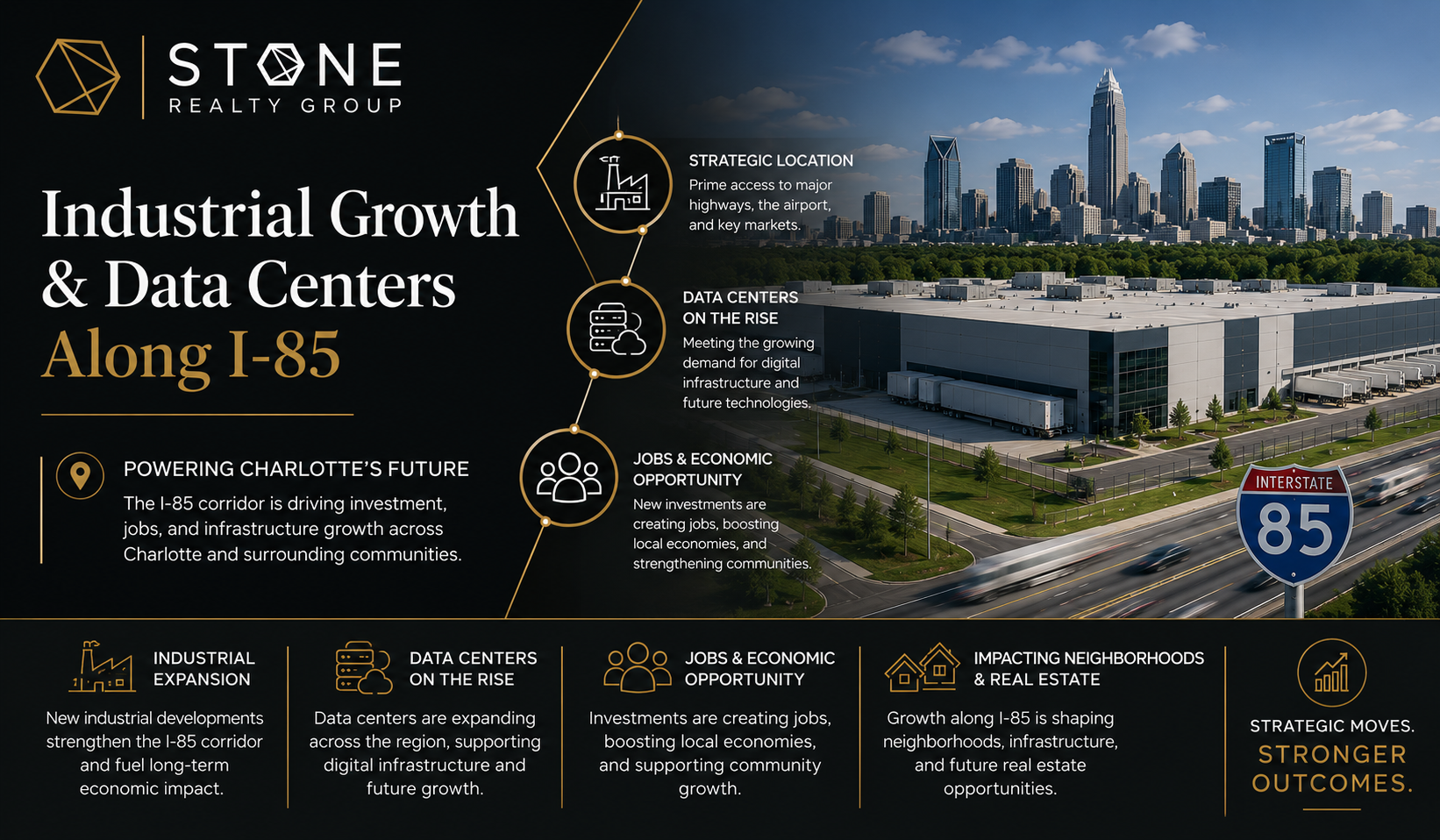
Industrial Growth and Data Centers Along Charlotte’s I-85 Corridor
Charlotte continues to evolve beyond banking and finance. One of the region’s most significant economic trends is the growth of industrial development and increased interest in data centers along and near the I-85 corridor.
Stretching through areas such as University City, North Charlotte, Concord, Harrisburg, and Cabarrus County, this corridor supports logistics, manufacturing, distribution, technology infrastructure, and regional employment.
For buyers, sellers, and investors following the Charlotte real estate market, this is more than a commercial development story. Industrial expansion can influence infrastructure planning, traffic patterns, employment access, and how nearby land is used.
Why the I-85 Corridor Is Attracting Investment
I-85 is one of the Southeast’s most important transportation routes. It connects Charlotte with Atlanta, the Triad, and other major markets while providing access to freight networks, rail systems, and Charlotte Douglas International Airport.
Areas near North Tryon Street, Mallard Creek, and University City also offer proximity to established residential communities, employment centers, and major transportation connections. Those advantages have made industrial developers increasingly active around Charlotte and neighboring communities such as Concord and Kannapolis.
The CBRE Charlotte Industrial Figures report for the second quarter of 2026 recorded 1.3 million square feet of net absorption and more than 4 million square feet of leasing activity. Vacancy declined slightly to 7.1%, while approximately 5.4 million square feet remained under construction.
CBRE also identified data center suppliers as an emerging source of industrial demand, connecting the region’s traditional logistics market with its growing digital infrastructure sector.
Data Centers Are Becoming Part of Charlotte’s Growth Story
Data centers house servers and other equipment used to process, store, and transmit digital information. These facilities support cloud computing, artificial intelligence, streaming services, telecommunications, and everyday online activity.
North Carolina can appeal to data center developers because of its land availability, electrical infrastructure, transportation access, and fiber networks. Proposed and approved projects around Charlotte have also raised questions about energy use, infrastructure capacity, noise, environmental considerations, and compatibility with neighboring properties.
On June 8, 2026, Charlotte City Council approved a 150-day moratorium on new data center applications. According to the City of Charlotte’s data center guidance, the pause runs through November 5, 2026, while officials evaluate infrastructure capacity, noise, environmental impacts, and potential policy changes.
The moratorium does not stop existing facilities or projects that were approved or had complete applications before the pause began.
What This Could Mean for Charlotte Homebuyers
Industrial and technology investment can create ripple effects across nearby residential markets, but those effects are not automatically positive or negative.
University City, Highland Creek, Concord, Harrisburg, and parts of North Charlotte may continue attracting buyers who value access to I-85 and nearby employment corridors. Additional commercial investment may also support road improvements, services, and retail development.
Growth can create tradeoffs. Buyers should consider potential traffic, noise, utility infrastructure, construction activity, and future land-use changes when evaluating a property near industrial sites or large undeveloped parcels.
Before purchasing, buyers may benefit from reviewing:
- Current zoning and nearby rezoning petitions
- Approved and proposed development projects
- Commute patterns during peak hours
- Planned road and infrastructure improvements
- The location of industrial facilities relative to the property
- Municipal and county long-range development plans
Understanding where and how growth is occurring can be just as important as selecting the home itself.
What Sellers and Investors Should Watch
For sellers, proximity to I-85 and major employment centers can be a useful marketing point when it translates into practical commuting access. However, the effect of nearby industrial development depends on the type of project, its distance from the property, and its impact on traffic, noise, and surrounding land use.
Investors should avoid assuming that every large commercial announcement will increase residential values. Data centers, in particular, can represent substantial capital investment without creating the same number of permanent jobs or daily visitors as a major office campus or manufacturing facility.
The more useful questions involve where infrastructure is being added, how zoning may change, and whether surrounding residential demand is supported by multiple employers and amenities.
Charlotte Real Estate Remains a Long-Term Story
Charlotte’s economy extends across banking, healthcare, logistics, manufacturing, technology, and digital infrastructure. This diversification helps explain why development patterns can vary significantly across the region.
The I-85 corridor may look different five or ten years from now as industrial projects, transportation improvements, and new development policies take shape. For homebuyers and homeowners, following those changes can provide useful context when comparing communities and evaluating long-term plans.
Frequently Asked Questions
Are data centers good for Charlotte’s economy?
Data centers can bring substantial capital investment, construction activity, and supporting infrastructure. However, they may create fewer permanent jobs than other large employers and can raise concerns involving electricity demand, noise, water use, and compatibility with surrounding land uses.
Which areas could be influenced by I-85 growth?
University City, North Charlotte, Concord, Harrisburg, Kannapolis, and parts of Cabarrus County may experience continued interest because of their access to I-85 and regional employment centers. The effect on individual properties will depend on location, inventory, zoning, property condition, and neighborhood-level demand.
Will industrial growth increase nearby home values?
There is no universal answer. Employment and infrastructure investment can support housing demand, while traffic, noise, and incompatible land uses may create concerns for some buyers. Mortgage rates, housing inventory, property condition, and local development plans also affect value.
Considering a Move Near Charlotte’s Employment Corridors?
Stone Realty Group helps buyers, sellers, and investors evaluate current housing conditions alongside zoning, infrastructure, and development trends. If you are considering a move near University City, North Charlotte, Concord, Harrisburg, or Cabarrus County, contact Stone Realty Group for property-specific and neighborhood-specific guidance.
Check out this article next