
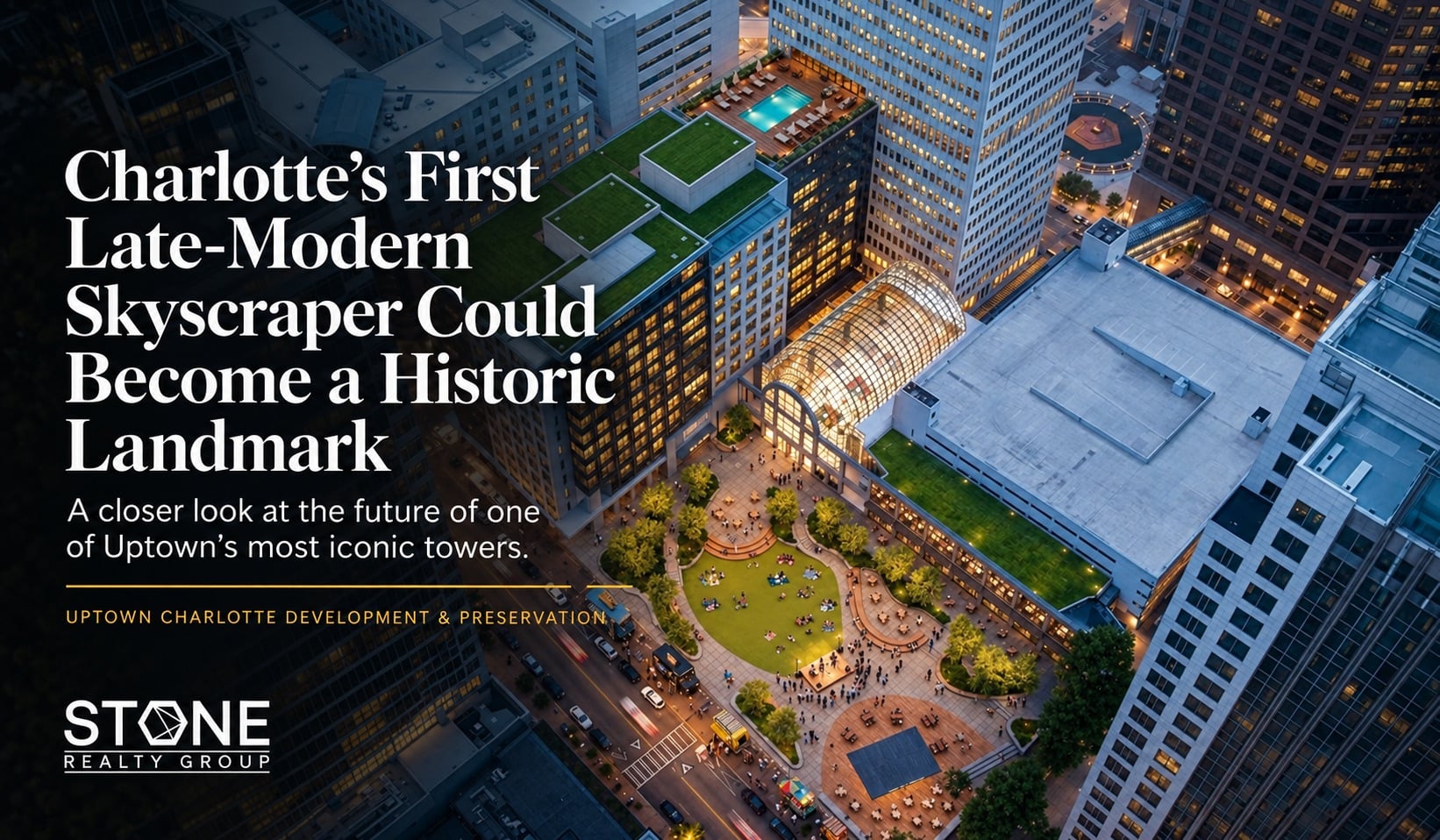
One of Uptown Charlotte’s most recognizable office towers could soon carry a new distinction.
The 1971 Jefferson-First Union Tower at 301 S. Tryon Street is being considered for local historic landmark status because of its role in reshaping Charlotte’s skyline and supporting the city’s emergence as a major banking center.
The 32-story building is recognized as Charlotte’s first Late-Modern skyscraper and was the tallest building in Charlotte and North Carolina when it was completed.
Why 301 S. Tryon Is Historically Significant
The tower marked a turning point for South Tryon Street and the surrounding business district. Its construction was followed by several major banking towers during the 1970s, creating much of the Uptown skyline Charlotte residents recognize today.
According to the Charlotte-Mecklenburg Historic Landmarks Commission designation report, the tower was designed by prominent Charlotte architecture firm J.N. Pease and Associates. Its exterior concrete structure, repeated vertical elements and monumental scale are key examples of Late-Modern architecture.
The proposed designation would include the tower’s exterior, its connecting 12-story “Hyphen” building, part of the surrounding land and selected interior features. Protected interior elements would include portions of the lobby, travertine wall and column cladding, cruciform columns, historic mail chutes and the configuration of each floor’s circulation and mechanical core.
The designation would not include the older mid-rise office building, parking garage, later atrium or the plaza added during subsequent phases of the complex.
A $200 Million Mixed-Use Redevelopment Is Planned
Historic designation would not mean freezing the property in time. Riverside Investment & Development and Singerman Real Estate purchased the 3.4-acre complex for $36.5 million in April 2026 and are planning an extensive mixed-use redevelopment.
According to Riverside’s redevelopment plans, the approximately $200 million project currently includes:
- Approximately 275 apartments in the upper portion of the tower
- Approximately 200 hotel rooms below the residential floors
- At least 250,000 square feet of renovated office space
- Approximately 30,000 to 40,000 square feet of retail
- A redesigned public plaza with additional green space and improved connections
The developers have said the project’s scope could change as permitting, financing and preservation reviews move forward.
When Could Construction Begin?
Riverside currently expects construction to begin in early 2027. Renovations to the shorter office building could be completed first, potentially in early to mid-2028. The remainder of the development may open in late 2028 or early 2029.
Those dates remain preliminary and could change based on approvals, financing, construction conditions and final project plans.
What Happens Next?
The City of Charlotte has scheduled a public hearing for September 28, 2026. City Council would consider and vote on the landmark designation after the required public-hearing process.
The current property owner supports the designation request, according to the City Council record.
For Uptown, the larger story is the combination of preservation and adaptive reuse. Instead of replacing another older office tower, the 301 S. Tryon project could add housing, hospitality and street-level activity while preserving architecture tied directly to Charlotte’s banking history.
Frequently Asked Questions
Is 301 S. Tryon already a historic landmark?
Not yet. The property is moving through the local designation process, with Charlotte City Council scheduled to hold a public hearing on September 28, 2026. Council action would follow the required hearing process.
Can the building still be redeveloped if it becomes a landmark?
Yes. Landmark status does not prevent redevelopment, but proposed alterations affecting protected historic features generally require additional review and approval. The recommended designation does not cover every building or public space within the larger complex.
Are the planned residences apartments or condos?
The current redevelopment concept describes approximately 275 multifamily apartments in the upper portion of the tower. The announced plans do not describe those residences as for-sale condominiums.
Why does this matter for Uptown Charlotte real estate?
Projects such as 301 S. Tryon add residential, hospitality and retail uses to an area historically dominated by offices. Buyers watching Uptown, Third Ward and nearby South End should pay attention to how these conversions affect housing supply, street-level activity and the experience of living in Center City.
Following Uptown Charlotte’s continued evolution? Explore more from Stone Realty Group on development, housing and Center City growth:
Considering a Move Near Uptown Charlotte?
Major redevelopment can change individual blocks quickly, but the impact on real estate varies by building, property type and neighborhood.
If you are comparing Uptown, South End or nearby Charlotte neighborhoods, explore our Charlotte real estate and community resources or connect with Stone Realty Group for local guidance based on your specific move.
Check out this article next