

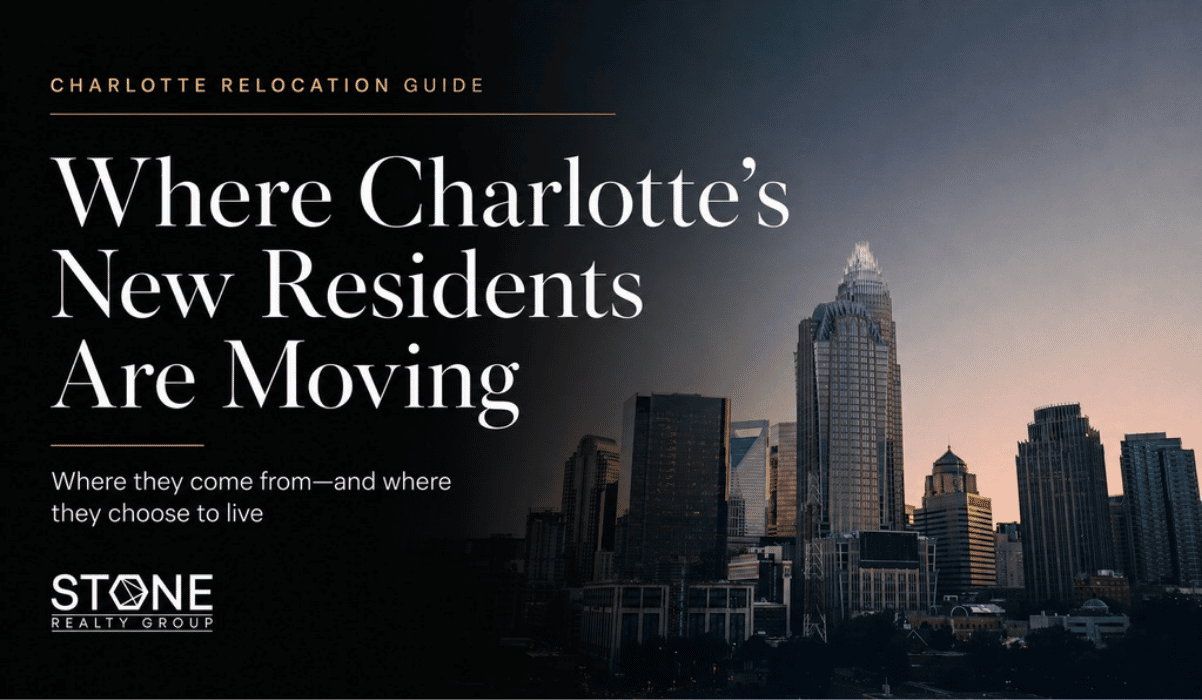
Charlotte continues to attract newcomers looking for career opportunities, more space and a lifestyle that can be difficult to achieve in larger coastal cities. Recent migration data also reveals a clear pattern: people are not simply moving to Charlotte. They are choosing specific communities based on commute, housing style, schools and daily life.
Where Are Charlotte’s New Residents Moving From?
The 16-county Charlotte Region gained 49,324 residents through migration between July 1, 2024, and July 1, 2025, which equals approximately 135 newcomers per day. During the same period, the Charlotte metropolitan area ranked first nationally for domestic migration, adding 30,358 residents from within the United States.
According to the Charlotte Regional Business Alliance, recent American Community Survey data identifies New York City, Miami, Philadelphia, Washington, D.C., and Los Angeles as major sources of newcomers.
The U.S. Census Bureau’s migration tables use American Community Survey responses to compare a resident’s current location with where that person lived one year earlier.
Where Are Newcomers Choosing to Live?
There is no single Charlotte relocation neighborhood. New residents typically narrow their search by commute, budget, housing type and preferred lifestyle.
South End, Uptown, NoDa and Plaza Midwood
Newcomers seeking restaurants, nightlife and proximity to major employers often begin their search in South End, Uptown Charlotte, NoDa or Plaza Midwood. These neighborhoods offer a mix of condos, apartments, townhomes and established residential streets.
South End, Uptown and NoDa provide direct or nearby access to the LYNX Blue Line. Plaza Midwood offers a strong local dining and entertainment scene but does not have a direct Blue Line station.
Ballantyne, South Charlotte and Matthews
Buyers looking for larger homes, suburban neighborhood layouts and access to South Charlotte employment centers often explore Ballantyne, Providence Plantation, SouthPark and Matthews. Buyers for whom school assignments are an important consideration should confirm current boundaries directly with Charlotte-Mecklenburg Schools or the appropriate local district because assignments can change.
Huntersville, Cornelius and Lake Norman
Lake Norman communities remain popular with buyers who value waterfront recreation, established neighborhoods and access to northern Charlotte employment centers. Huntersville provides a suburban setting closer to Charlotte, while Cornelius and Davidson offer a more lake-centered lifestyle.
Steele Creek, Fort Mill and Surrounding Counties
Steele Creek attracts buyers seeking newer construction near Charlotte Douglas International Airport and major highways. Other newcomers expand their searches into Fort Mill, South Carolina, as well as Union, Cabarrus, Gaston and Iredell counties for additional housing options.
Regional construction supports this broader search pattern. Mecklenburg, York, Cabarrus, Union, Gaston and Iredell counties collectively added thousands of housing units between 2024 and 2025.
What This Means for Charlotte Homebuyers
The right Charlotte neighborhood is not determined by a national ranking. It comes down to how commute time, housing costs, school assignments, property type and lifestyle fit together.
Stone Realty Group helps relocating buyers compare those tradeoffs before committing to an area, whether that means an Uptown condo, a South Charlotte home, a Lake Norman community or new construction outside Mecklenburg County.
Frequently Asked Questions
What cities send the most new residents to Charlotte?
Recent migration-flow data identifies New York City, Miami, Philadelphia, Washington, D.C., and Los Angeles as major sources of newcomers. Charlotte also attracts residents from other communities throughout North Carolina and the Southeast.
What are the best Charlotte neighborhoods for newcomers?
South End and Uptown may suit buyers seeking an urban lifestyle, while Ballantyne, Matthews, Huntersville and Lake Norman provide more suburban or lake-oriented options. The best fit depends on budget, commute, housing type and location priorities.
Should I rent before buying in Charlotte?
Renting can help you experience an area before purchasing, but it is not always necessary. A relocation-focused real estate agent can help you compare neighborhoods remotely, tour homes virtually and evaluate commute patterns before your move.
More Charlotte Relocation & Neighborhood Guides
Continue planning your move with these Stone Realty Group resources:
Planning a Move to Charlotte?
Stone Realty Group can help you compare neighborhoods, housing options, commute times and local market conditions with a relocation strategy built around your priorities. Contact our Charlotte real estate team to start planning your move.
Check out this article next